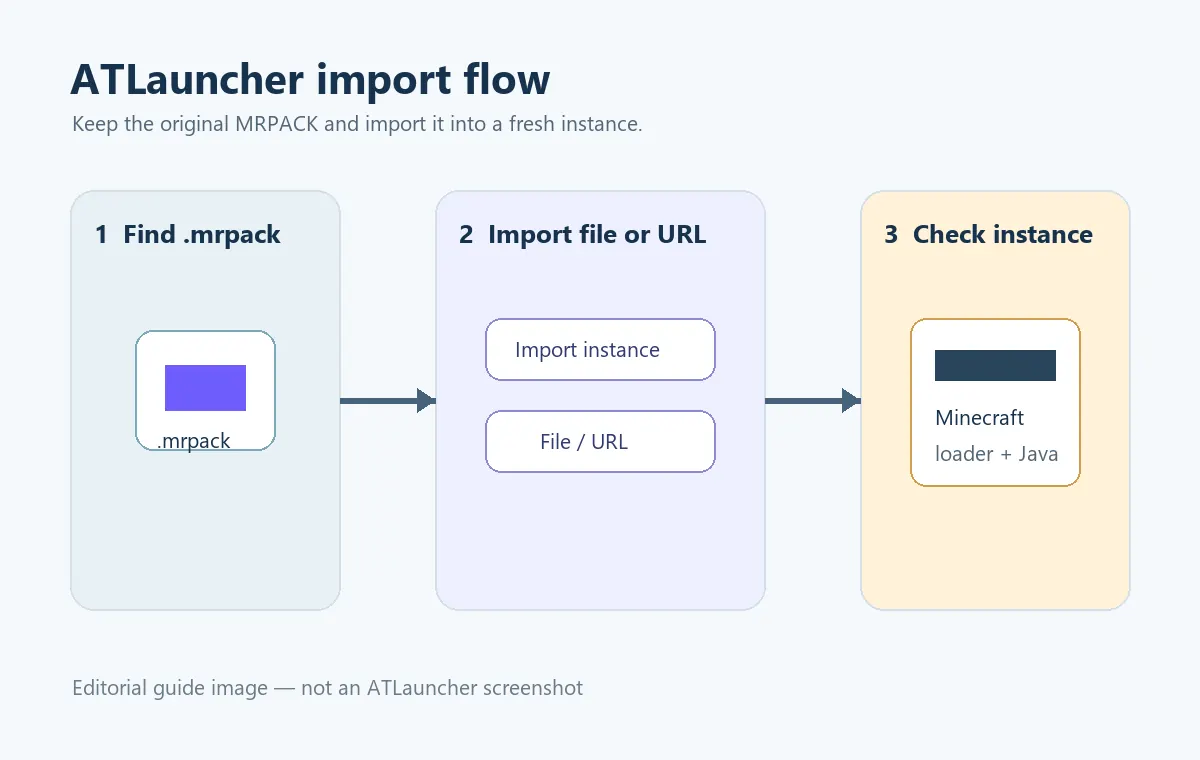
What you need before importing
Start with the right file. An MRPACK is a Modrinth modpack package, not a generic folder backup. It normally contains a root-level modrinth.index.json manifest, an overrides directory for pack configuration, and references to mod files that the launcher can download. The manifest is what tells a compatible launcher which Minecraft version, loader, file paths, hashes, and download sources belong to the pack.
You need three practical things:
- A complete
.mrpackfile from the Modrinth project’s version or download flow. Keep the original extension. - An up-to-date ATLauncher installation with permission to create an instance and write to its instance directory.
- Enough disk space and a working network connection for the manifest’s referenced files. The MRPACK itself can be small while the completed instance is much larger.
When possible, save the file locally first. A local file avoids problems caused by an expiring link, a project page that is not a direct download, a login session, or a redirect that ATLauncher cannot follow. If you only have a URL, use a trusted direct pack URL and keep a local copy if the import does not complete.
How to install MRPACK in ATLauncher
1. Confirm the pack and file source
Open the Modrinth project and select the exact version you intend to use. Check the Minecraft version and loader shown for that release. A pack built for Fabric should not be treated as a Forge pack, and a pack for one Minecraft version may not launch correctly on another simply because the archive opens.
Download the actual MRPACK asset rather than saving an HTML project page with a .mrpack name. If the download is unusually small, opens as text, or has a second extension such as .mrpack.html, download it again. Do not rename a ZIP or a web page to make it look like an MRPACK.
2. Open ATLauncher’s instance import workflow
Launch ATLauncher and go to the area where you create or manage instances. Choose the option for importing an instance or pack. The exact button label can vary between ATLauncher builds, so look for the import action rather than relying on one fixed screen name. ATLauncher’s own documentation describes importing an instance from a file or URL; use that workflow instead of dragging the archive into an existing profile.
For a local file, browse to the downloaded .mrpack. For a URL, paste a direct link to the pack file, not the Modrinth project landing page. If both choices are available, the local file is easier to troubleshoot because it does not depend on a redirect or a live session.
3. Let ATLauncher create the new instance
After you select the source, review the proposed instance details before confirming. Use a name that identifies the pack and version, and choose a separate instance location if you are testing a pack that might conflict with an existing profile. Do not overwrite a working instance just to retry an import.
ATLauncher should use the pack metadata to prepare the Minecraft version, loader, overrides, and referenced downloads. Let the process finish. Closing the launcher while files are being resolved can leave an instance that looks created but is missing mods or configuration files.
4. Wait for downloads and read the result
A completed import is more than a new icon in the instance list. Review the import result or log for missing downloads, blocked hosts, checksum failures, and permission prompts. Some MRPACK files reference content hosted by more than one service. A browser or launcher may be unable to fetch one host even when the manifest itself is valid.
If the result lists a small number of unavailable files, record their names before launching. You may be able to obtain an allowed replacement or reinstall the pack from a newer version. Do not silently substitute unrelated mod files; a replacement can change dependencies or make the pack unstable.
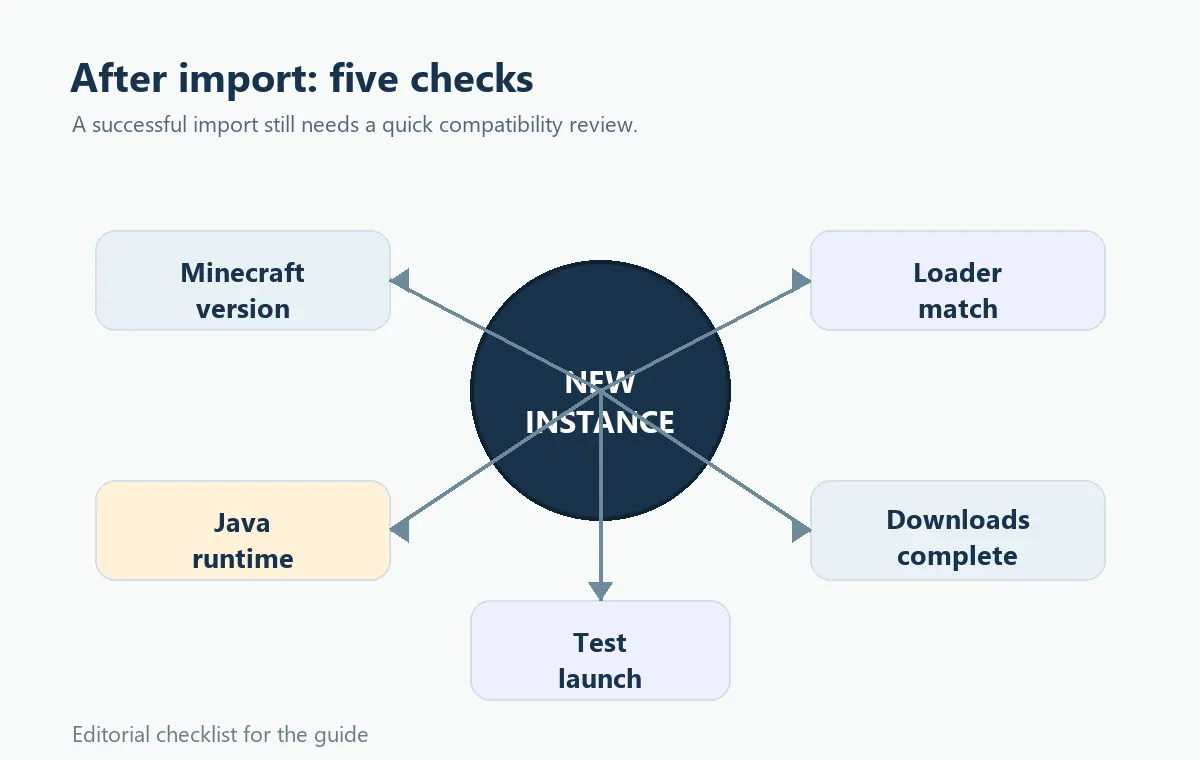
The five checks to make before launching
- Minecraft version: Match the version declared by the pack. Do not change it casually to make a different mod appear compatible.
- Loader: Confirm Fabric, Forge, NeoForge, or another declared loader is present. A loader mismatch can look like a missing-mod problem.
- Java runtime: Use the Java version required by the Minecraft release and pack. If ATLauncher exposes an automatic Java selection, verify the selected runtime instead of assuming it is correct.
- Overrides and configuration: Make sure the instance includes the pack’s configuration files and resource folders. A pack that launches with defaults may still be incomplete.
- First launch: Test in a disposable world or copy of an existing world. Watch the log for missing dependencies, invalid mixins, or a crash that names one mod.
Why ATLauncher imports fail
Most failed imports fall into a few repeatable categories. The file may be incomplete, the URL may not be a direct asset, or the archive may not be a real MRPACK. Another common issue is a valid manifest with a download source that is unavailable, rate-limited, removed, or blocked by network policy.
| Symptom | Likely cause | Safe next step |
|---|---|---|
| ATLauncher rejects the file immediately | Incomplete download, wrong archive type, or missing root manifest | Download the pack again and inspect the archive for modrinth.index.json. |
| URL import never finishes | Project page, redirect, expired signature, or login-gated URL | Use the official direct asset URL or download the MRPACK locally first. |
| Instance exists but mods are missing | External host failure, blocked download, or interrupted import | Read the import log, retry the failed files, and do not replace them with random versions. |
| Instance launches and crashes | Loader, Java, Minecraft version, or dependency mismatch | Compare the instance settings with the pack release and test with a clean world. |
Use the MRPACK Reader when you need to inspect a local file without importing it. It can help you see the declared dependencies, file paths, overrides, hashes, and client/server environment before you change an ATLauncher instance.
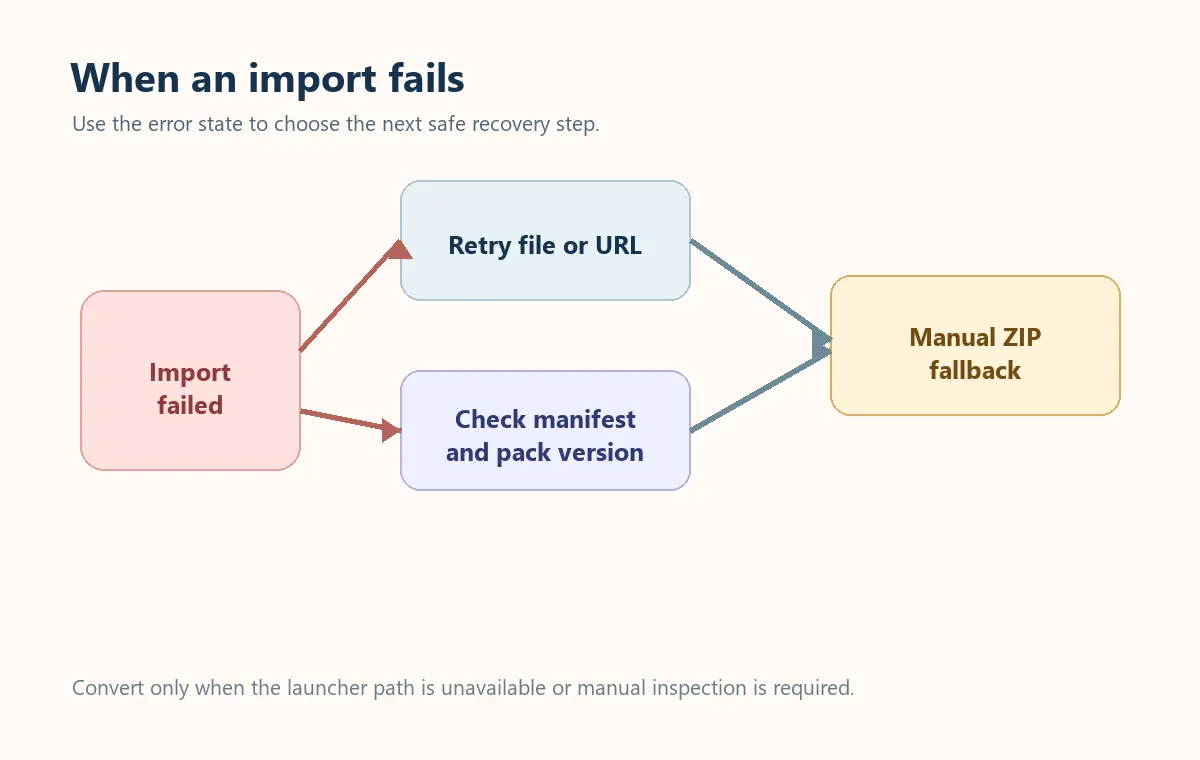
When should you convert MRPACK to ZIP?
Direct import is normally the cleanest ATLauncher path because the MRPACK manifest keeps the pack’s dependency references and version information together. ZIP conversion is useful when you need to inspect the archive, copy files manually, prepare a server workflow, or move the contents into a launcher that does not understand MRPACK.
Conversion does not repair missing downloads or create a native ATLauncher instance. A converted ZIP can contain overrides and successfully downloaded files, but it may not contain every dependency referenced by the original manifest. If you need a ZIP, use the site’s MRPACK to ZIP guide and keep the original MRPACK as the source of truth.
For a general launcher decision, see how to install MRPACK files in Minecraft. That guide compares native import, manual installation, server setup, and conversion. For a file that you only need to inspect, how to open an MRPACK file explains why opening an archive is not the same as installing its dependencies.
FAQ
Can ATLauncher install MRPACK files?
Yes. Import the complete file as a new instance through ATLauncher’s import workflow. After the instance is created, verify the pack’s Minecraft version, loader, Java runtime, and dependency downloads before you launch.
Where should I put an MRPACK file for ATLauncher?
Keep it in a normal download or archive folder and select it through the importer. Do not place the raw MRPACK inside .minecraft/mods; that folder is for mod files, not a pack manifest and its overrides.
Why does ATLauncher say the MRPACK is invalid?
Check whether the download is complete and whether modrinth.index.json is at the archive root. A project page saved as a file, a renamed ZIP, or an interrupted download can all fail before ATLauncher reaches dependency installation.
Should I convert MRPACK to ZIP first?
Usually not. Convert only when you need manual inspection, server preparation, or a launcher path that cannot import MRPACK directly. Keep the original file so you can retry the native workflow later.
Can I use an MRPACK URL instead of downloading it?
If your ATLauncher version offers URL import, use a trusted direct file URL. Avoid a project page, a link that requires login, or a temporary signed URL that may expire while the import is running. A local download is easier to reproduce when troubleshooting.
Bottom line
To install MRPACK in ATLauncher, import the original pack into a new instance, wait for dependency downloads, and verify the version, loader, Java runtime, overrides, and first launch. If the import fails, repair the source or manifest path first. ZIP conversion is a useful manual fallback, but it should not replace the metadata-aware import workflow when ATLauncher can handle the MRPACK directly.